
Quick answer: Membranes and coatings protect wide surfaces such as terraces and bathroom floors. PU injection stops water in wet cracks, and epoxy repairs dry ones. Flexible sealants close the joints between building sections.
Which method covers a surface?
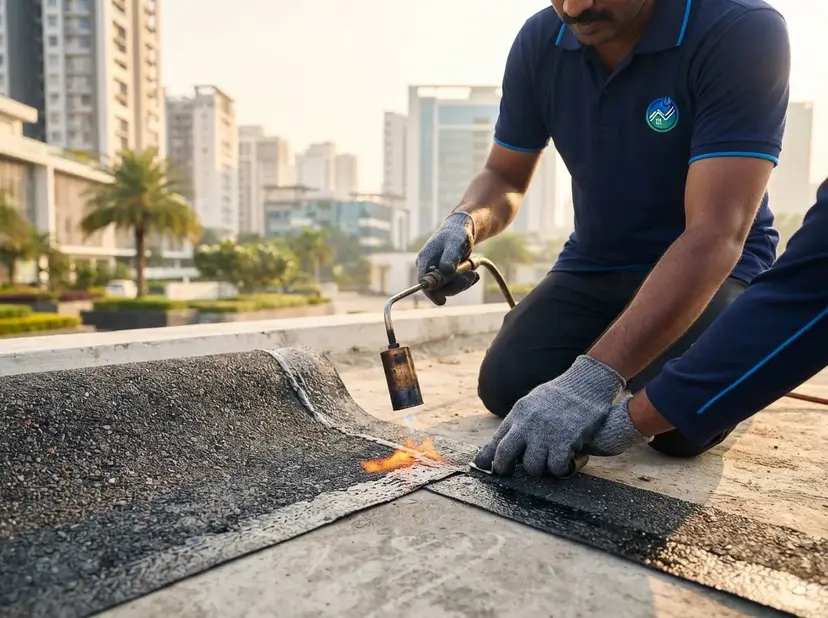
APP membrane
Best for large flat concrete roofs. It is a thick sheet, joined with heat. Do not leave it bare where people walk. Read about APP membrane.
Cement coating
Best under tiles in bathrooms, sunken floors and tanks. It is brushed on in layers. Seal the joints and pipes first.
Fibre coating
Best for corners, balconies and fine cracks. The fibre keeps the coating from splitting. The surface must be firm. Read about fibre waterproofing.
Which method fills a gap?
PU injection
Best for cracks with running water. It swells and blocks the path. It adds no strength. Read about PU injection.
Epoxy injection
Best for dry cracks in concrete that have stopped moving. It bonds both sides. Read about epoxy injection.
Joint sealing
Best for the gap between two parts of a building. It must stay soft. Never use cement here. Read about expansion joints.
Can two methods be used together?
Yes, and they often are. A wet basement is injected first and coated after it dries. A terrace gets crack repair, fibre at the corners and a coating over everything.
Which method is the cheapest?
Crack filling and joint sealing cost the least, because the area is small. Coatings and membranes cost more per job because they cover the whole surface.